 Go back

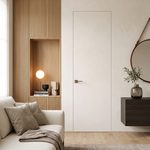


The Salone del Mobile 2025 has decisively sanctioned one of the strongest and most transversal trends in contemporary design: the return of soft shapes.
After years dominated by square volumes, clean geometries and rigorous minimalism, today the house softens, rounds, and becomes more fluid.
In two words, more human.
A change of direction that involves interior design at all levels, from macro-architecture to furnishings, down to the smallest of details. And handles, naturally, are no exception.

A trend that arises from a need
But what pushed the world of design towards this rediscovery of soft lines?
The answer is to be found in the evolution of the post-pandemic living sensibility.
In an era in which homes have become refuges and settings of everyday life, the need for comfort, empathy and security has taken centre stage in the aesthetic debate.
Soft shapes, compared to sharp ones, are more welcoming, instinctive, and closer to nature.
They refer to organic elements, body movements, landscapes. They are familiar and reassuring, but at the same time refined. They offer a visual sensation of fluidity and a softer and more pleasant tactile perception.
As more than one designer underlined during talks at the exhibition, “curved lines speak to the emotional part of those who inhabit the living space. They create harmony, reduce tension, and bring calm”.

The interpretations of the big brands
Many international brands interpreted this new need with different languages but with a clear common denominator: the curve as a compositional principle.
- Molteni&C, with its generously shaped upholstered furniture and oval stone tables, has redefined the balance between formal elegance and comfort.
- Flexform proposed sofas with rounded lines and fluid armrests, capable of enveloping those who sit on them.
- Roche Bobois revisited its icons such as the Mah Jong with more immersive and continuous configurations.
- Poliform presented collections in which curves and rounded connections are absolute protagonists, even in the most structured systems.
- Even in accessories, from Kartell to Magis, the trend has made itself noticed: seats, lamps and containers bend to softness, abandoning any formal rigidity.

Materials and finishes that follow the gesture
This evolution is not limited to the form, but also involves the product materials. The surfaces become tactile, velvety, and opaque.
Warm materials, such as wood, bouclé fabric and metals with a satin finish, further underline the enveloping effect.
Colours also follow this trend: palettes become warmer, softer, and favour tones that are natural, earthy, sandy, powdery, mustard, terracotta, sage green and dusty blue.
Everything contributes to creating a visual and sensorial language that reassures and welcomes.

Linea Calì’s answer: when aesthetics embraces gesture
In this new scenario, the handle also returns to the role of protagonist, not only for the function that it performs, but for the formal and sensorial value it represents.
We fully embrace this vision, proposing collections in which the curve is a sign, a gesture and a style.
Handles with almost organic shapes, smooth and full, which do not show edges but surfaces that follow the palm, which invite contact, which furnish in a discreet but elegant way.
Models like the ones we are about to show you become perfect to accompany contemporary environments that seek visual coherence and tactile harmony.

Point
A collection of handles devoid of any frills and therefore extremely sophisticated and unique in its kind.

Ibis
Sinuous lines chase each other, giving life to a natural shape that ideally recalls a branch on which an Ibis, an American bird with plumage as red as the sunset, has rested.

Spirit
The bold and seductive shapes of a flower give life to this particularly sexy and unusual collection of handles.

Nau
A design spiral that, thanks to its unusual silhouette, acts as an element of separation and connection with the surrounding space.

Kendo
nspired by the Shinai, the sword used by the Samurai, this collection defines a new path in contemporary design.
And so, in an era in which every furnishing choice is an extension of one’s way of living and feeling, even the handle, however small, becomes language, emotion, gesture.
And so, in an era in which every furnishing choice is an extension of one’s way of living and feeling, even the handle, however small, becomes language, emotion, gesture.

A new beauty to
The return of soft shapes is not simply a trend. It is a paradigm shift.
It is the sign of a design that slows down, listens, connects, rediscovers its most human and sensitive dimension. And in this scenario, our handles represent an invitation to look at (and touch) beauty in a new light.
Because opening a door is not just a gesture. It is a small daily ritual.
An in that gesture, there is room for form, for comfort, for emotion.
There is room for a handle that follows the hand. But also the heart.

